Programme Design
Loyalty programme onboarding
Plan loyalty programme onboarding from the signup promise to a member’s first eligible action, with clear account and reward status.
Loyalty programme onboarding should help a new member understand the benefit, the next eligible action and when the benefit can be used.
Map the journey from invitation through enrolment to first activity. Check that the account, checkout and staff explanation give consistent answers.
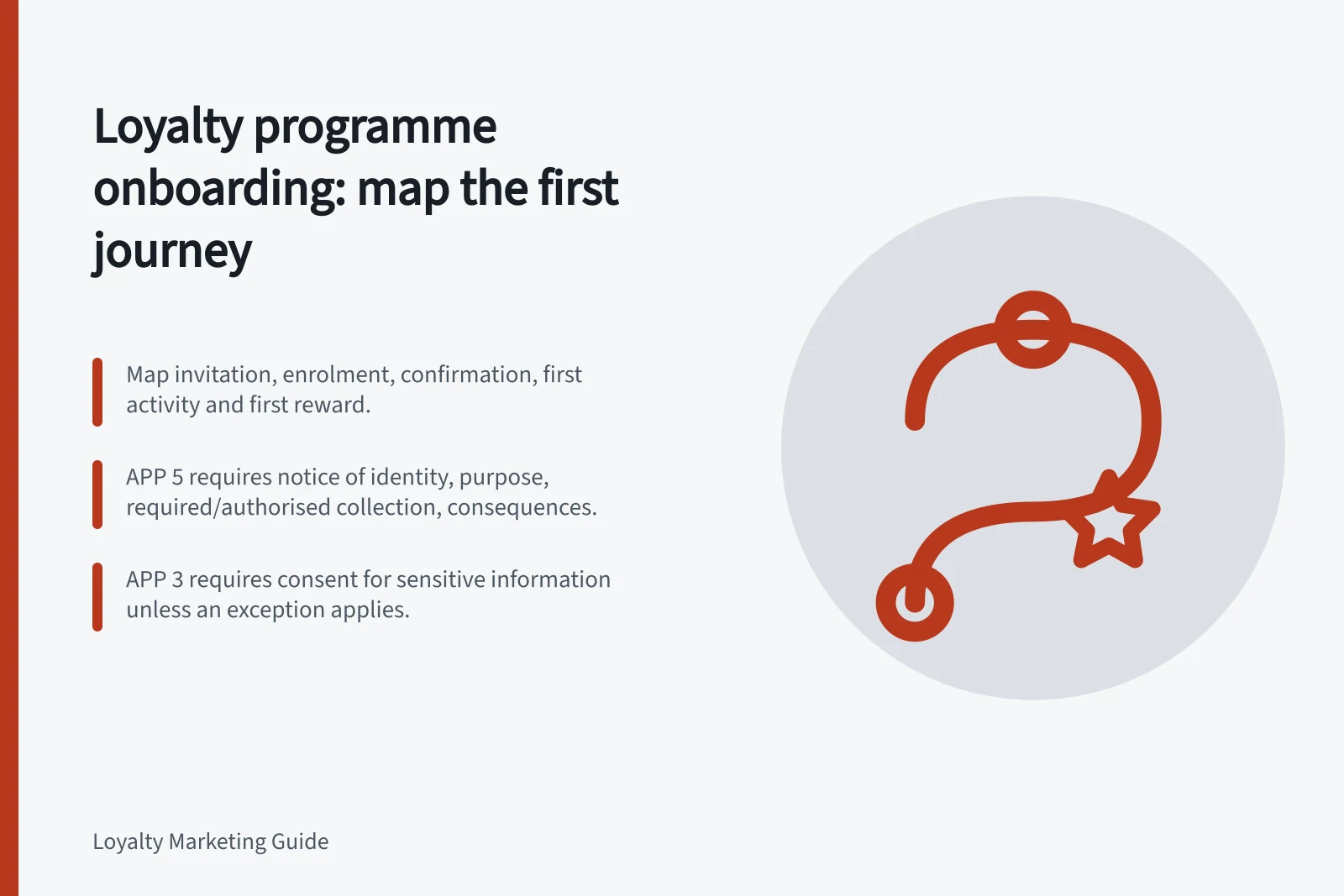
Map the first journey
| Moment | What the member needs to know | What the business needs to check |
|---|---|---|
| Before joining | The benefit, any fee and the main conditions | The offer can be delivered as described |
| Enrolment | What information is needed and what happens next | The form and collection notice fit the intended data use |
| Confirmation | Whether membership is active or another step remains | The account can be found in the relevant channels |
| First activity | What qualifies and when progress or value appears | The activity can be matched to the member |
| First reward | What is available now and what still needs to happen | The displayed status matches the rules |
This map does not call for five messages. Put each explanation where the member makes the decision. A confirmation screen, for example, can show the next step immediately.
Onboarding journey: invitation to first reward
- Before joiningThe benefit, any fee and the main conditions; check the offer can be delivered as described
- EnrolmentWhat information is needed and what happens next; check the form and collection notice fit the intended data use
- ConfirmationWhether membership is active or another step remains; check the account can be found in the relevant channels
- First activityWhat qualifies and when progress or value appears; check the activity can be matched to the member
- First rewardWhat is available now and what still needs to happen; check the displayed status matches the rules
Carry the signup promise through
Describe the benefit in ordinary terms. Distinguish anything received on joining from value earned later. Put material exclusions, minimum spends, expiry and channel limits beside the claim they qualify. Do not describe points as a cash saving unless the programme rules provide that saving.
The signup page explains why someone might join. Onboarding must then make the same promise understandable in the account and at the point of use.
If a member must identify themselves before paying, say how to do that in each eligible channel.
Check the invitation claims
Before an invitation goes live, keep a record of the information that supports each claim about a benefit or service. The ACCC can require a business to back up claims it makes, and may investigate and take compliance or enforcement action if a business misleads.
If a member reports a potentially misleading claim, the ACCC uses reports to inform its education, compliance and enforcement work; it does not resolve individual disputes. Ensure the invitation and the explanations members see after joining describe the same offer, so a claim is not left unsupported or contradicted later.
Request data for a clear purpose
For each enrolment field, identify the task it serves now. A question intended only for a possible future campaign may be better asked later. Make optional choices clear. Where the offer treats marketing preference and joining as separate choices, distinguish them.
For organisations covered by the Australian Privacy Principles, collecting solicited personal information must be reasonably necessary for their functions or activities. Those organisations must also assess their collection notification duties. A short form alone does not settle either requirement.
After submission, show whether the account is active, needs verification or could not be created. Do not present pending value as spendable.
Enrolment data purpose checks
- For each enrolment field, identify the task it serves now
- Make optional choices clear
- Distinguish marketing preference and joining where they are separate choices
- For APP-covered organisations, check collection is reasonably necessary for functions or activities
- Assess collection notification duties
- Show whether the account is active, needs verification or could not be created
Give collection information at the right time
For entities covered by the Australian Privacy Principles, APP 5 requires reasonable steps to notify a person of specified matters or ensure they are aware of them. These include the collecting entity’s identity and contact details, why the information is collected, whether collection is required or authorised by law, and the consequences of not providing it.
The notice must also cover the entity’s usual disclosures of that kind of information, its APP Privacy Policy, and whether information is likely to be disclosed to overseas recipients. Include the countries where recipients are located if practicable.
Take reasonable steps before or when collecting the information. If that is not practicable, do so as soon as practicable afterwards.
The steps needed depend on the circumstances, including how sensitive the information is, the possible adverse consequences of collection and any special needs of the person. More rigorous steps may be needed where information is sensitive or the person may not readily understand the notice. Consider these factors when deciding how to present the notice in the enrolment journey.
APP 5 collection notice checklist
- Collecting entity’s identity and contact details
- Why the information is collected
- Whether collection is required or authorised by law
- Consequences of not providing the information
- Usual disclosures of that kind of information
- APP Privacy Policy
- Whether information is likely to be disclosed to overseas recipients, including countries if practicable
- Timingtake reasonable steps before or when collecting, or as soon as practicable afterwards
Apply extra care to sensitive information
APP 3 sets different requirements for sensitive information. An APP entity may collect it only where the applicable collection conditions are met and the individual consents, unless an exception applies.
Personal information must be collected by lawful and fair means. Collect it from the individual concerned unless that is unreasonable or impracticable, or an applicable exception applies. Check these conditions when deciding whether an enrolment field is needed and how the member will be asked to provide it.
Show the next useful action
Give the member one relevant next step: identify the account on a qualifying purchase, inspect an available benefit or check how progress is recorded. If an expected award does not appear, provide a way to query it. Support staff need the applicable rule and transaction record to explain whether activity is pending, excluded or missing.
Before inviting members, review the proposed journey with a new account, an ineligible activity and a member approaching the first reward. After launch, examine questions and unexpected outcomes alongside enrolments. A signup count cannot show whether members understood how to participate.
In this guide
- Explaining programme value at signupWrite a loyalty signup promise that explains immediate value, future benefits and material limits before a customer joins.
- Keeping enrolment forms proportionate to the benefitDecide which loyalty enrolment fields are needed now, explain each request and keep joining distinct from later data uses.
- Measuring whether new members understand how to participateCheck whether new loyalty members understand eligibility, progress and first reward use through tasks, events and support evidence.