Programme Design
Designing a customer loyalty programme
Plan a customer loyalty programme around a clear goal, a usable member benefit, workable rules and a way to assess its effect.
Design a loyalty programme around one customer behaviour you want to change and a benefit you can deliver reliably. Before you choose points, tiers or a membership fee, check whether customers have a reason to return, what the offer will cost and how you will measure its effect.
Start with a programme brief
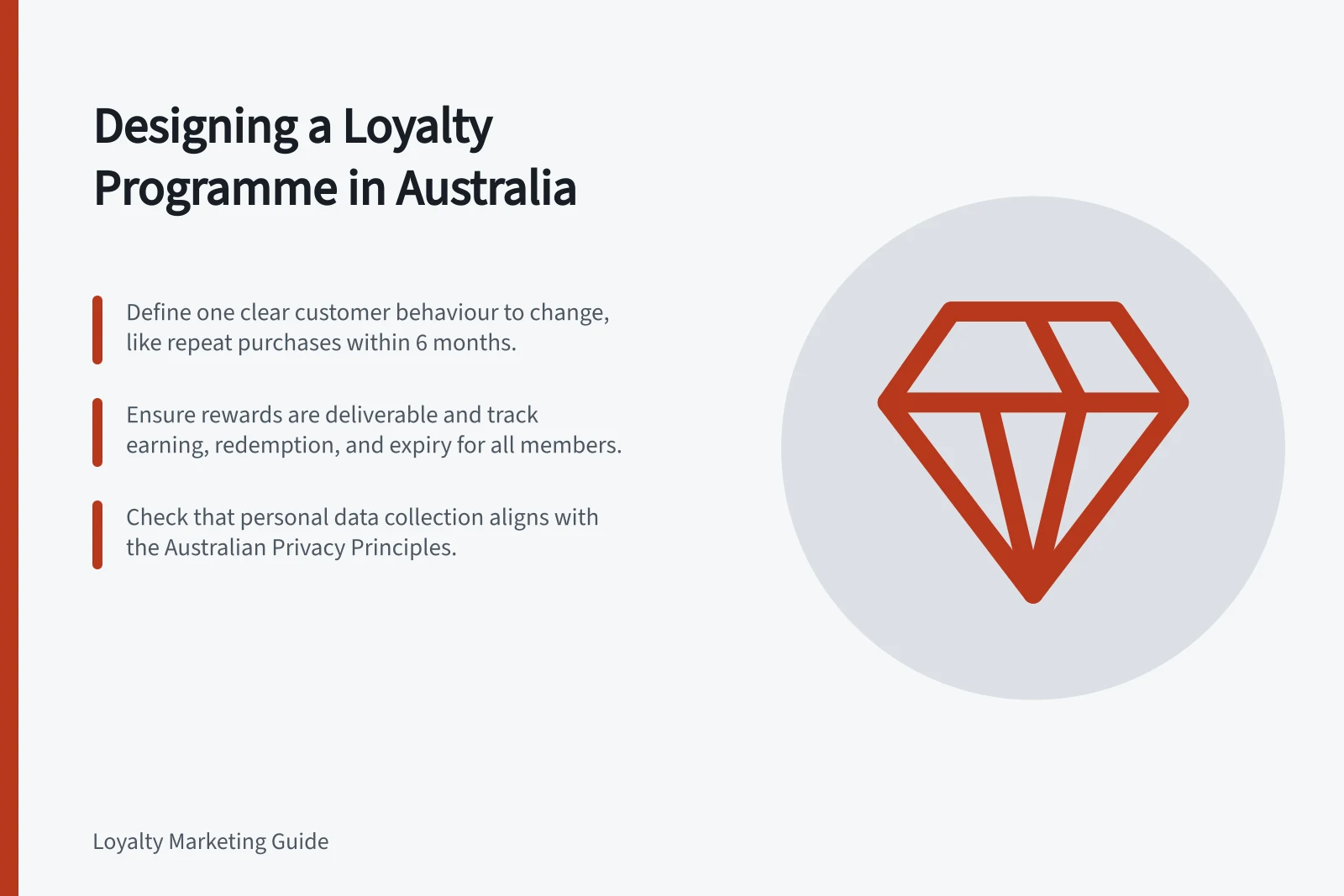
Describe the customer, what they do now and the next action you want to encourage. “More loyal customers” is too broad to guide an offer. “More eligible first-time buyers make a second purchase” names a behaviour you can design for and measure.
Review purchase intervals and repeat rates before setting a reward threshold. Separate customers who could reasonably return soon from those whose next need may be years away. Record the current experience too. If availability, delivery or service is driving customers away, fix that problem before expecting a reward to change their behaviour.
The brief should name one primary outcome, who can join, the proposed benefit, the review period and a spending limit. Treat these as design assumptions until your own data supports them.
Choose a promise members can use
Points build towards a reward. Tiers give qualifying members different benefits. Paid membership charges a fee for stated benefits. Formats can be combined, but each extra rule creates another promise to explain and fulfil.
| Format | Question to answer | Commitment to check |
|---|---|---|
| Points | Can an ordinary eligible customer reach a useful reward? | Record earning, redemption, reversals and any expiry. |
| Tiers | Are the higher-level benefits valuable and deliverable? | Explain qualification, benefit availability and downgrades. |
| Paid membership | Is useful value available during the paid term? | Deliver the benefits and explain the fee, renewal and cancellation terms. |
Walk through the offer as a member would. What do they get for joining? What must they do next?
When can they use a benefit, and what might prevent its use? Simplify the promise if those answers take too long to explain.
Loyalty Programme Formats: Pros and Considerations
- PointsCan an ordinary eligible customer reach a useful reward? Check earning, redemption, reversals, and expiry records.
- TiersAre higher-level benefits valuable and deliverable? Explain qualification, benefit availability, and downgrades.
- Paid MembershipIs useful value available during the paid term? Deliver benefits and clarify fee, renewal, and cancellation terms.
Pros and Cons of Paid Membership Loyalty Programmes
- Pros
- Higher customer commitment, predictable revenue, exclusive benefits
- Cons
- Risk of alienating price-sensitive customers; requires ongoing value delivery
Check value on both sides
A member should have a plausible path to value without buying things they do not need. Estimate whether the extra contribution the programme might generate can cover rewards, service, software and administration. Purchases by people who enrol are not, by themselves, evidence that the programme caused those purchases.
Model a new customer, a typical repeat customer and an infrequent customer using your own order history. Include returns and discounts. Check when each could first use a reward and what the offer would cost if eligible members used it. These are planning scenarios, not tested results.
Write rules for the whole journey
Draft the member-facing explanation before selecting software. Cover eligibility, qualifying purchases, when benefits become available, where they work, and what happens after a return, cancellation or failed claim. Show material expiry and tier-loss rules where members make the relevant decision. For a paid offer, state the fee and any renewal and cancellation arrangements plainly.
Map each promise to an owner and a transaction record. Staff need to see which purchase produced an award, why a benefit was unavailable and how to correct an error. If online and in-store purchases both count, confirm the same customer and order can be recognised consistently before promising a shared balance.
For an Australian offer, check its overall impression as well as its detailed terms. A prominent benefit should not depend on a material restriction buried in fine print. If your organisation is covered by the Australian Privacy Principles, assess whether the personal information requested at enrolment is reasonably necessary for its functions or activities.
For personal information other than sensitive information, an organisation covered by the Australian Privacy Principles may collect it only where it is reasonably necessary for the organisation’s functions or activities. Soliciting information includes explicitly asking someone to provide it or taking active steps to collect it, so consider each enrolment field and collection method rather than treating the form as a single request.
Sensitive information has additional conditions: it may be collected only where the relevant necessity conditions are met and the person consents, unless an exception applies. Personal information must also be collected by lawful and fair means, and generally from the individual concerned unless that is unreasonable or impracticable.
Support the promise with evidence
Before publishing an offer, keep records that support the claims members will see, including claims about earning, access to benefits and likely value. The Australian Competition and Consumer Commission (ACCC) can require businesses to back up claims about their products or services, and may investigate misleading claims or take compliance or enforcement action.
Plan account safeguards alongside the customer journey if members can hold or redeem benefits through accounts. Australian Loyalty Association contributors describe screening events from account creation through account updates and redemptions, using patterns in event data and signals such as the device used. They also recommend detecting suspicious access before the customer reports it, while considering friction points that avoid burdening legitimate members.
Give members a clear way to report missing benefits or account concerns, and give staff an escalation path. The ACCC accepts reports about potentially misleading behaviour and uses them to inform its education, compliance and enforcement work, but it does not investigate individual complaints. Your own support process therefore needs to handle individual member issues.
Plan the launch review
Set a baseline before launch. Track the primary outcome alongside participation, successful benefit use, complaints and programme cost. Where practical, compare eligible customers offered the programme with a suitable comparison group; people who choose to enrol may already be more engaged. Record promotions, price changes and service changes that could affect the result.
Check the proposed purchase, redemption and return journeys in the systems that will handle them before inviting customers. Give support staff the rules and a way to escalate discrepancies. Set a review date and decide in advance what would lead you to continue, revise or stop the programme.
Key Metrics to Track Before and After Launch
- Baseline primary outcome
- e.g., repeat purchase rate among first-time buyers
- Participation rate
- Percentage of eligible customers who enrol
- Successful benefit use
- Number of rewards redeemed vs. issued
- Programme cost per member
- Includes rewards, software, administration, and service
In this guide
- Points, tiers and paid memberships comparedCompare points, tiers and paid loyalty memberships by member value, fit with buying behaviour and the work needed to deliver each promise.
- Choosing a loyalty programme goalSet a loyalty programme goal around one defined customer action, a suitable measurement period and checks on cost and member experience.
- Deciding when a loyalty programme is not the right solutionUse practical go, revise and stop checks to decide whether a loyalty programme fits the customer problem, the benefit and your delivery capacity.