Programme Design
Part of Designing a customer loyalty programme
Choosing a loyalty programme goal
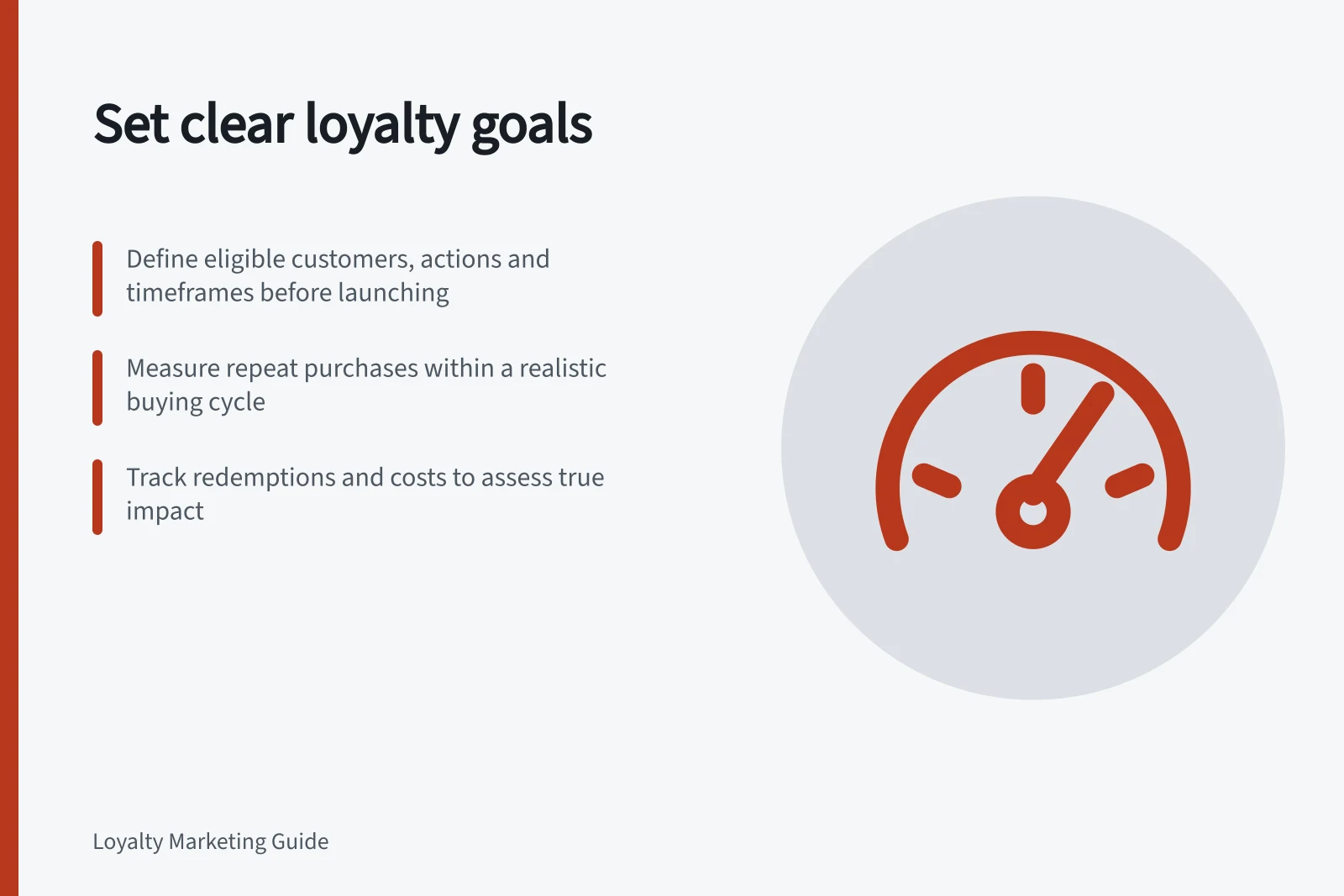
Set a loyalty programme goal around one defined customer action, a suitable measurement period and checks on cost and member experience.
Choose one customer outcome that a loyalty programme could plausibly change. Define who counts, what action counts and when you will look for it. “Increase engagement” is too vague to guide a reward or show whether the programme worked.
Start with the behaviour
Write down the commercial problem before discussing points or benefits. Are first-time buyers failing to return? Are established customers buying less often?
Are previously active customers no longer buying? These call for different goals, and a loyalty offer may not be the right response to each one.
| Problem to investigate | Possible primary goal | Measure to define before launch |
|---|---|---|
| Eligible first-time buyers seldom return | Increase second purchases | Share of a defined first-purchase cohort making another eligible purchase within a suitable period. |
| Established customers visit less often | Improve repeat frequency | Eligible purchases per customer over a period matched to the normal buying cycle. |
| Previously active customers have stopped buying | Increase return among a defined lapsed group | Share of that group making an eligible purchase within a specified period. |
These are candidate goals, not findings about any business. Check your own customer history before choosing one. A café and a furniture retailer, for example, should not automatically use the same return window.
Define the measure and its guardrails
For the primary measure, write down the eligible group, starting event, outcome event and observation period. Decide how to handle refunds, inactive customers and purchases that cannot be matched across channels. Keep these definitions consistent through the review.
Add guardrails for reward and administration cost, margin on affected sales, unsuccessful benefit claims and complaints. Redemptions show that members used a benefit; they do not, on their own, show profitable additional purchases. Benefit use is also a useful service measure when the offer is hard to claim, even if it is not the primary commercial goal.
Do not make enrolment count the main success measure unless enrolment itself is the business objective. A sign-up can occur without a later purchase or usable benefit. Total member revenue also includes purchases those customers might have made anyway.
Decide how you will judge change
Record a pre-launch baseline. Where practical and appropriate, compare eligible customers offered the programme with a suitable group that was not offered it, and note other changes during the period, such as promotions, prices or availability. Members who choose to join may already differ from non-members, so a spending gap between the groups cannot by itself establish the programme's effect.
Set a review date before launch and agree what evidence would justify continuing, revising or stopping. If a credible comparison is unavailable, report the observed behaviour and the limits of what it shows rather than calling it incremental impact.
Check that the goal fits the offer
The target behaviour should be something the offer could plausibly influence. If customers leave because a promised service is unreliable, repairing that service is a more direct first action. If the next purchase is naturally rare, a repeat-purchase reward may be too distant to matter; another relationship goal may fit better.
A useful goal statement is: “For this eligible group, increase this defined action within this buying cycle, while keeping these costs and service measures within agreed limits.” Fill in the business's actual definitions before choosing the reward.