Programme Design
Part of Paid loyalty memberships
Explaining renewal and cancellation clearly
Explain paid-membership charges, automatic renewal, cancellation steps and the effect on benefits.
Before someone pays for a membership, they should be able to tell what they will be charged, whether it renews, how to stop a future charge, and what cancellation does to current benefits. Give those answers beside the joining decision; keep the relevant dates and account status available to the member.
ACCC Guidance on Subscription Transparency
- Misleading conduct case
- eHarmony found guilty by Federal Court for hiding total commitment costs.
- Consumer warning issued
- ACCC warns Australians about subscription traps in pricing displays.
- Disclosure requirement
- Ongoing fees must be clearly disclosed alongside monthly equivalents.
Explain the first commitment
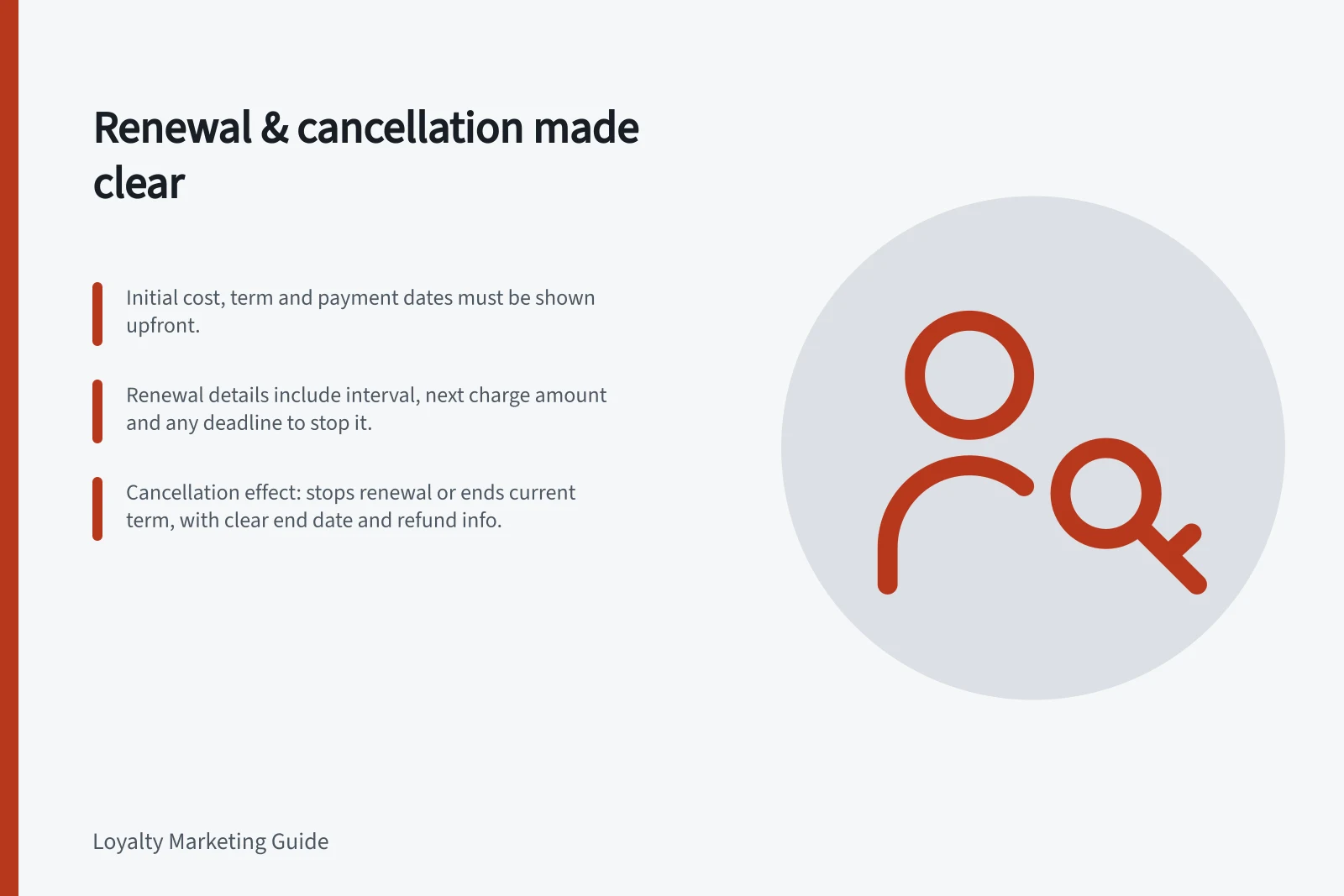
State the initial total cost, the term and each payment date. Say whether the membership ends automatically or renews, the renewal interval and how the next charge is determined.
If an introductory price changes on renewal, show that change clearly. If action is required to prevent renewal, state the applicable deadline and time zone.
A monthly equivalent must not hide a longer minimum commitment. In the eHarmony matter, the Federal Court found that eHarmony failed to display as a single price the minimum total amount a consumer would pay for a subscription alongside statements of how much a membership would cost per month. The ACCC has also called for clear disclosure of ongoing membership fees.
Describe the cancellation route and effect
Identify the actual route for requesting cancellation and the point at which a request takes effect. Explain whether it stops the next renewal or also ends the current term, whether any payments remain due under the agreed arrangement, and when benefit access ends.
Address unused vouchers, existing bookings and refund requests according to the offer’s terms. A phrase such as ‘cancel anytime’ should not suggest that the current term is refundable if cancellation only prevents renewal.
Keep the explanation consistent across joining copy, account controls, billing notices and support responses. A member should not need to infer a deadline from a billing date or search separate terms to discover a material restriction.
Confirm what happened
After a cancellation request, tell the member whether cancellation is complete, its effective date, the next charge status and when benefits end. Distinguish receipt of a request from its completion.
Where an automatic renewal is planned, a timely reminder can identify the upcoming charge and the action still available under the terms; suitable timing depends on the actual arrangement.
The ACCC’s reported eHarmony decision concerned misleading impressions about subscription duration, automatic renewal and early cancellation in that case. It does not establish one reminder period or refund outcome for every paid membership. Review the proposed wording and billing process against the actual contract before use.