Programme Design
Part of Loyalty programme onboarding
Keeping enrolment forms proportionate to the benefit
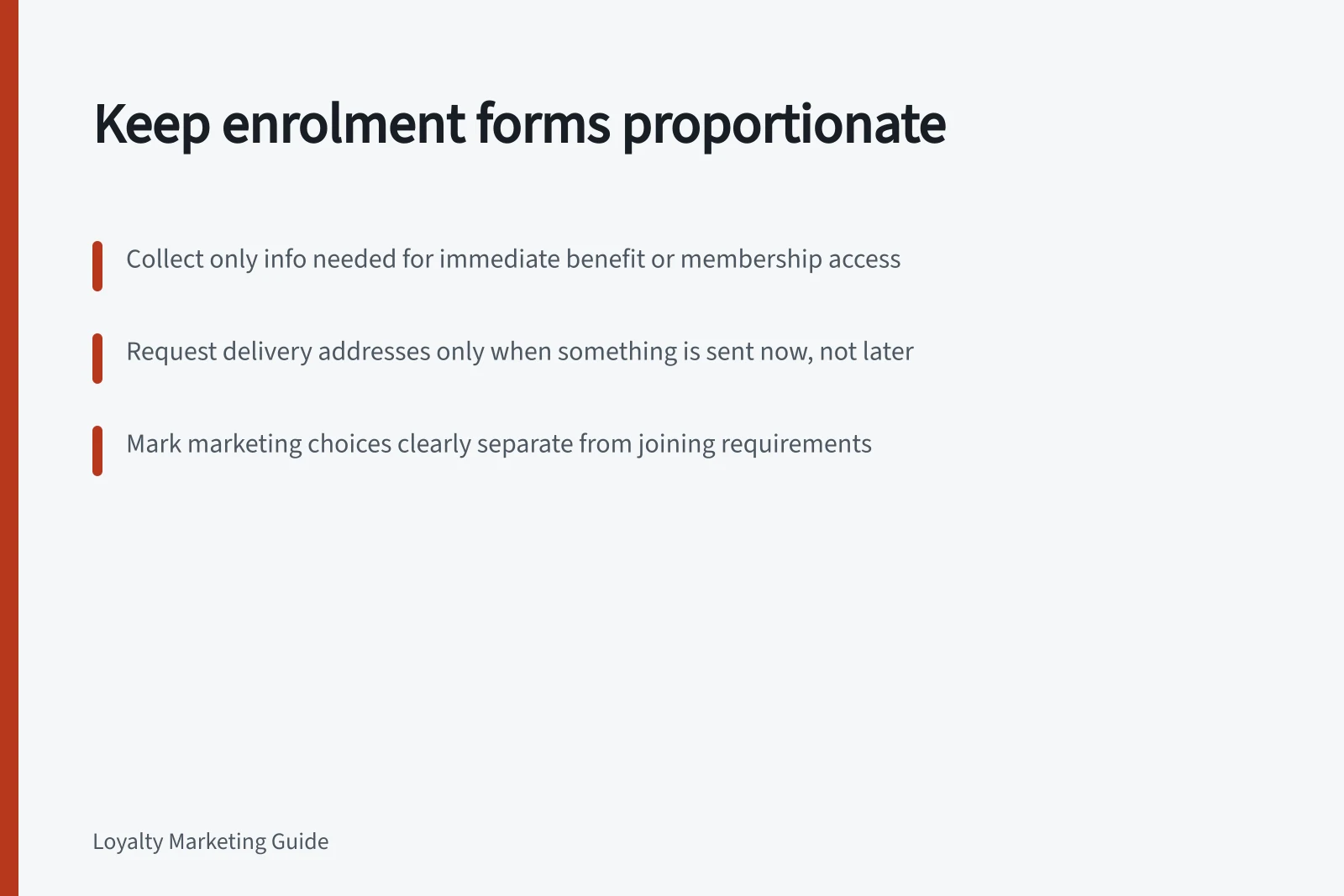
Decide which loyalty enrolment fields are needed now, explain each request and keep joining distinct from later data uses.
Ask for the information needed to enrol a member and deliver the stated benefit. Judge each field by what it enables now, whether a smaller request would suffice and whether it could wait until the member uses a later benefit.
Key compliance and usability principles for Australian loyalty forms
- Australian Privacy Principle (APP) 3 requirement
- APP 5 notification obligation
- Marketing consent must be distinct from joining
- Form design standard
Give every field a purpose
List each proposed field, why it is needed at enrolment and what happens if the member does not provide it.
| Possible field | Decision before including it |
|---|---|
| Account identifier or contact detail | Is it needed to create, find or secure the membership in this joining route? |
| Delivery address | Is something being sent now, or can the address be requested at claim? |
| Date of birth | Does a defined benefit need it, and would a less precise age check work? |
| Preference or profile answer | Does it affect the immediate service, or mainly a later campaign? |
| Marketing choice | Is it clearly distinguishable from joining, and can the choice be recorded? |
A future posted reward does not automatically justify collecting every member’s full address at sign-up. Equally, removing a necessary account identifier could prevent members from finding earned benefits. The right form depends on the offer and account design.
For organisations covered by the Australian Privacy Principles, solicited personal information must be reasonably necessary for their functions or activities. They must also take reasonable steps to notify individuals of the APP 5 matters, or ensure individuals are aware of them, at or before collection or as soon as practicable afterwards. Neither a short nor a long form is automatically compliant.
Reviewing enrolment form fields for proportionality
- Is the account identifier or contact detail needed to create, find or secure the membership?
- Is a delivery address required now, or can it be collected when claiming a reward?
- Does the date of birth affect an immediate benefit, or would a general age check suffice?
- Does the preference or profile question impact current service, or is it for future campaigns only?
- Is the marketing choice clearly separate from joining and properly recorded?
Make the form understandable
Before the fields, say who can join and what happens after submission. Use clear labels and mark optional questions. Keep instructions visible rather than relying on placeholder text that disappears when typing begins. Give errors a corrective action, such as “Enter an email address in the correct format”.
After submission, distinguish an active membership from one that still needs verification or could not be created. A submitted form should not be reported as a completed enrolment if the account was not created.
Use a single-column layout and group related fields, particularly if the form has several questions.
Steps to ensure compliance and usability in loyalty enrolment forms
- State who can join and what happens after submission
- Use clear labels and mark optional fields
- Keep instructions visible (avoid placeholder text)
- Provide corrective error messages (e.g., 'Enter an email address in the correct format')
- Distinguish active membership from pending or failed enrolments
- Use a single-column layout and group related fields
Keep later uses distinct
Membership, service messages and promotional messages can involve different purposes and choices. Explain what messages members can expect and keep any optional marketing choice distinct from joining. An unexplained marketing preselection should not make an optional choice look like a condition of joining.
If a later reward needs an address, request it when the member selects that reward and explain the use then. Review who can access the additional information.
Immediate vs. later data collection: When to ask for information
- Immediate need (collect at enrolment)
- Later need (collect when used)
Find the cause of friction
Compare form starts, errors and completed accounts, then observe intended users attempting the relevant joining routes. Abandonment alone does not show whether a question, the offer or a technical failure caused the problem. Revise the field or interaction supported by the evidence, and review the form when the benefit or data use changes.