Rewards and Benefits
Part of Loyalty communication
How to avoid too many messages about low-value benefits
Decide when a small loyalty benefit warrants a message, combine overlapping sends and respect member preferences.
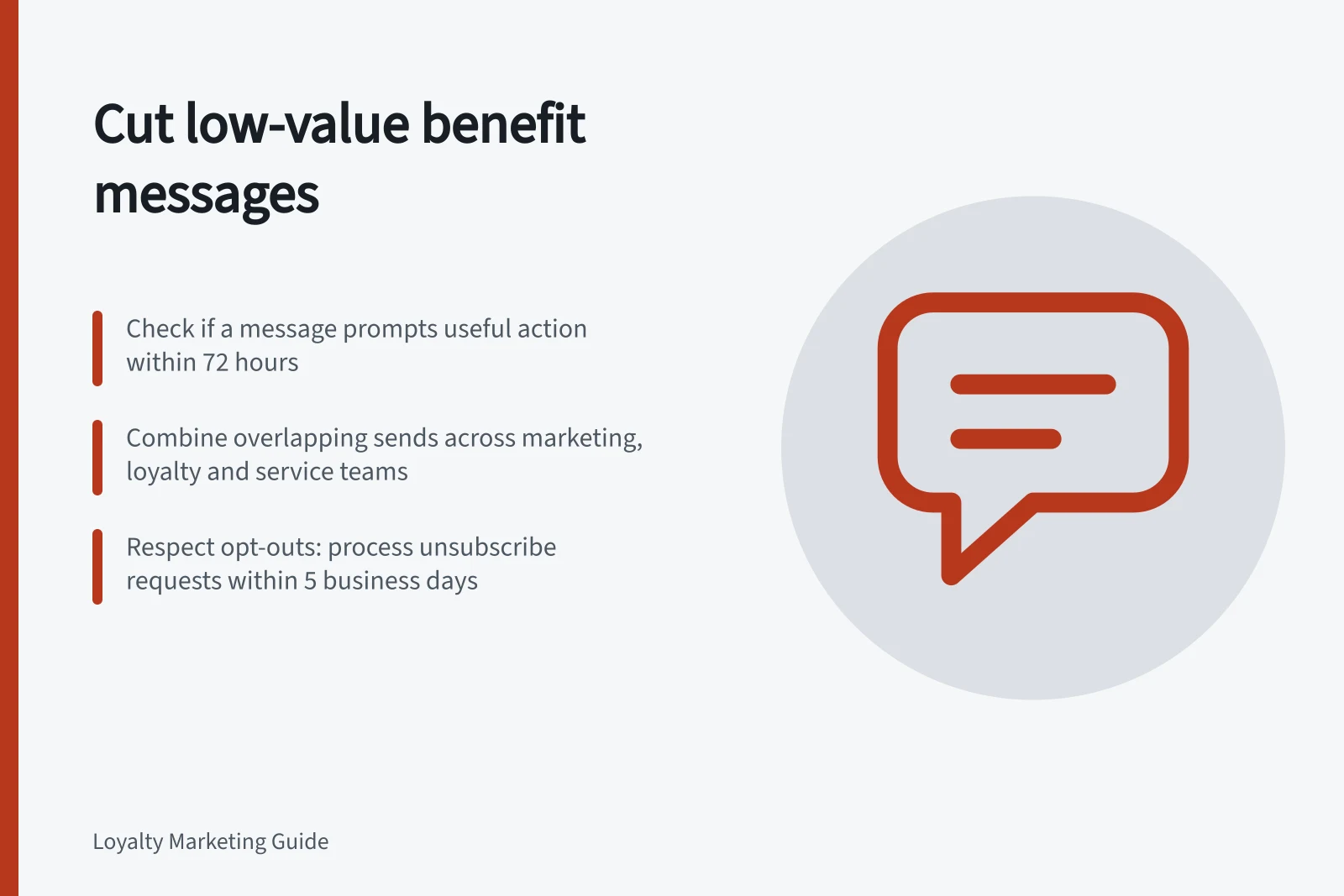
To avoid too many messages about low-value benefits, decide whether a separate send gives a member a useful action, combine overlapping sends across teams and respect member preferences. Then review send volume, opt-outs, complaints, support contacts and benefit use to see whether the revised sequence reduced repetition without hiding important expiry or change information.
Ask what the message adds
A modest benefit can matter when it becomes usable or is about to expire. A more valuable benefit may need no extra email if it is already clear at checkout. Ask what the member can do now, how long the opportunity lasts and whether the information is easy to find elsewhere.
| Proposed message | Decision to make | Possible treatment |
|---|---|---|
| A few more points were earned | Is immediate action needed? | Show the transaction and balance in the account; include them in a requested summary if useful. |
| A reward is now claimable | Is it usable under its actual conditions? | Consider one focused notice with the claim path and main limits. |
| An unchanged minor benefit still exists | Is anything new or time-sensitive? | Keep it discoverable in the account. |
| Earned value expires soon | What exactly will be lost and when? | Consider a targeted notice with the deadline and action. |
These are editorial choices, not measured thresholds. The appropriate treatment depends on the programme promise and the member’s preferences.
When to send a message vs. when to omit it
- Message: A few more points were earned
- Show transaction and balance in account; include in summary if useful
- Message: A reward is now claimable
- One focused notice with claim path and main limits
- Message: An unchanged minor benefit still exists
- Keep discoverable in the account — no separate message needed
- Message: Earned value expires soon
- Targeted notice with deadline and clear action
Coordinate sends across teams
Marketing, loyalty and service teams may each schedule a reasonable message while the member receives too many in total. Put planned messages in one shared send plan before release and check for triggers arising from the same event. If a reward becomes available as a regular update is due, one clear message may explain both.
Avoid a repeat claim prompt after a reward has been used or has become unavailable. Do not suppress an important expiry or change notice solely because a campaign went out recently. Before a triggered send, confirm eligibility against the current account record; prepared audience lists can become stale.
Respect preferences and channel rules
For promotional email or SMS, the Spam Act 2003 (Cth) governs commercial electronic messages, and the Australian Communications and Media Authority (ACMA) enforces the regime. Check prior opt-in consent, clear sender identification and a functional unsubscribe facility; process unsubscribe requests within five business days.
Record member preferences and honour opt-outs. Keep unsubscribe suppression lists central across teams so opt-outs are applied consistently.
A factual account notice may feel promotional if it includes a sale offer or links directly to promotional material. For direct marketing using personal information, consult the Office of the Australian Information Commissioner’s Direct marketing guidance and check the privacy rules that apply to your organisation and channel.
If you use telephone marketing, the Do Not Call Register Act 2006 (Cth) is a separate regime.
Compliance and performance indicators for message management
- Spam Act 2003 (Cth) requirement
- Prior opt-in consent and functional unsubscribe facility
- Do Not Call Register Act 2006 (Cth)
- Applies to telephone marketing
- Privacy guidance for direct marketing
- Office of the Australian Information Commissioner (OAIC)
Review the member’s experience
Track sends per member, opt-outs, complaints and support contacts alongside attempted and completed benefit use. Compare the revised sequence with its previous performance; if fewer sends coincide with rising opt-outs, complaints, support contacts or failed claims, revisit the timing, repetition and clarity. Campaign averages can hide members receiving repeated triggers.
Opens and clicks do not show whether a benefit was valued; low use might reflect weak value, poor visibility or difficult conditions. Read a sample of messages in the order a member would receive them. Remove repetition, clarify the action and check that the benefit can be claimed under its stated conditions.
Use later contacts and failed claims to assess whether the revised sequence helped.