Rewards and Benefits
Part of Refreshing an existing loyalty programme
Identifying benefits with little member use
Find underused loyalty benefits by separating entitlement, opportunity, attempts and completed use before changing the offer.
Measure completed use against members with a realistic opportunity to use the benefit. Then separate low interest from poor visibility, restrictive conditions and failed delivery. Redemption totals alone are a weak basis for removing a benefit some members rely on.
Define the opportunity
Start with the benefit's current terms. Record who was entitled, when it became available, where it could be used and what action counted as use. An issued voucher is not a voucher applied to an order. A booking is not an attended service.
Choose a period suited to the intended use occasion. Report newly entitled members separately from those entitled throughout the period. For a benefit limited to selected stores or times, identify members with a realistic opportunity under those limits. State gaps in channel data rather than treating an unrecorded attempt as no attempt.
Measure / Question it answers
- Entitled members
- Who could use the benefit under its terms?
- Members who saw or received the offer, where measurable
- Was it likely to be noticed?
- Members who attempted a claim
- Did eligible members try to use it?
- Members who completed a use
- Who received the benefit?
- Failed or abandoned attempts
- What interrupted use?
Name the denominator for every rate. Members with a completed use divided by entitled members answers a different question from completed attempts divided by recorded attempts. If repeat use is allowed, report both distinct users and total completed uses.
Measuring Benefit Use: Key Metrics and What They Reveal
- Entitled members
- Who could use the benefit under its terms?
- Members who saw or received the offer (where measurable)
- Was it likely to be noticed?
- Members who attempted a claim
- Did eligible members try to use it?
- Members who completed a use
- Who received the benefit?
- Failed or abandoned attempts
- What interrupted use?
Diagnose the gap
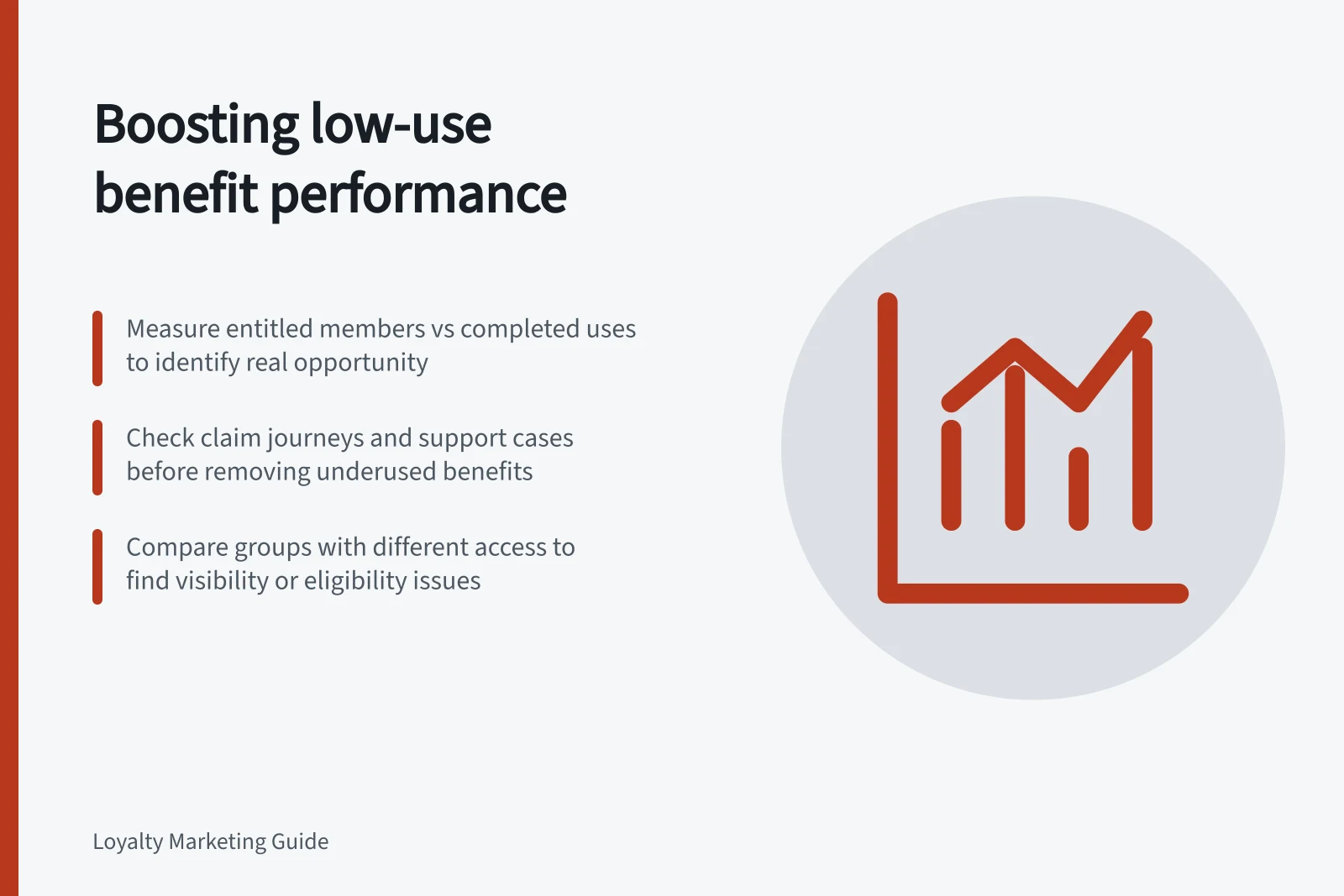
Inspect claim journeys and support cases before changing the benefit. Low measured exposure with successful claims may suggest a visibility problem. Many attempts with few completions call for a check of checkout, stock, booking capacity and eligibility messages.
Good exposure with little use may suggest weak relevance, but ask intended members about the complete offer before reaching that conclusion.
Compare groups whose opportunity differs. An infrequent buyer may have little chance to use a purchase-linked reward; a regional member may be unable to reach a metropolitan event. Review the cost and staff effort of completed uses, too. Low cost caused by an unusable promise is a delivery problem, not an efficiency gain.
Diagnosing Low Benefit Usage: A Step-by-Step Approach
- Inspect claim journeys and support casesLook for patterns in member interactions before making changes.
- Assess visibility vs. relevanceLow exposure with successful claims? Visibility issue. Many attempts, few completions? Check checkout, stock or eligibility messaging.
- Compare groups with differing opportunitiesConsider regional access, purchase frequency, or store availability.
- Review cost and staff effort of completed usesLow cost due to unusable promises indicates delivery failure, not efficiency.
Choose a response
Improve the claim path if members want the benefit but cannot complete it. Clarify conditions that people repeatedly misread. Change future eligibility or replace the benefit if it remains unattractive under realistic conditions. Before withdrawing it, identify existing entitlements and the transition members were promised.
Set a review date and record what would change the decision: better discovery, fewer failed attempts, more completed uses among members with a real opportunity, or a cost the business can support.
Choosing the Right Response to Underused Benefits
- Improve the claim pathIf members want the benefit but can't complete it, simplify the process.
- Clarify confusing conditionsAddress repeated misinterpretations of terms.
- Adjust eligibility or replace the benefitIf the benefit remains unattractive under realistic conditions.
- Before withdrawal: identify existing entitlements and promised transitionsEnsure fairness and compliance with consumer standards.
- Set a review date with clear triggersE.g., better discovery, fewer failed attempts, more completed uses among entitled members.