Programme Refresh
Part of Refreshing an existing loyalty programme
Deciding whether to simplify or close a loyalty programme
Compare repair, simplification and closure of an existing loyalty programme while accounting for earned rewards, member notice and data.
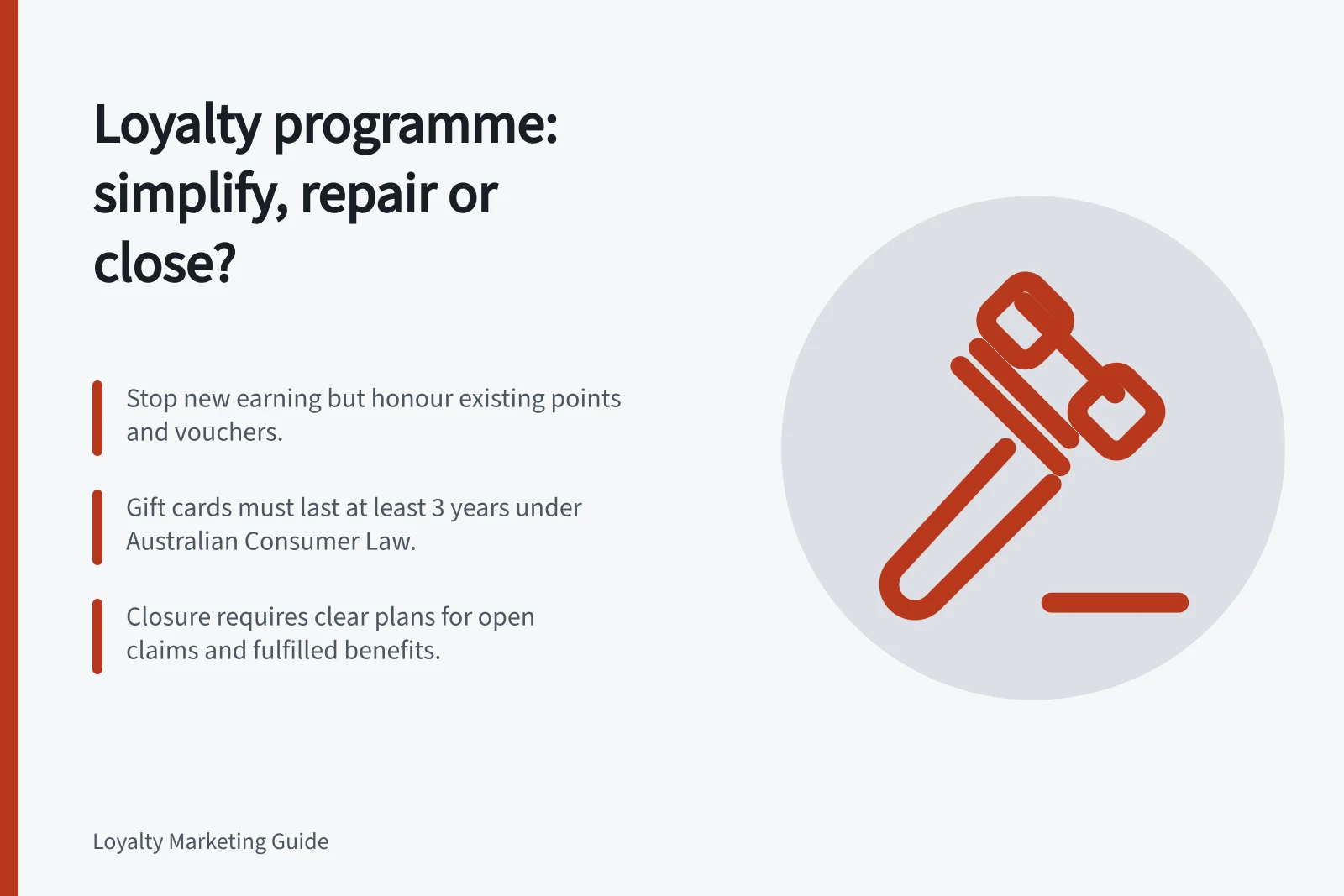
Start with repair when the evidence points to a specific, fixable failure. Simplify when a smaller, clearer offer can still deliver a usable core benefit within the business’s limits; close when no viable purpose or deliverable offer remains. In every case, account for what members already hold: stopping new earning does not resolve points, vouchers or benefits already issued.
Compare the alternatives
Write a decision case for repairing the current programme, simplifying it or closing it. Use the same member group and period for each. Review completed benefit use, failed claims, complaints, fulfilment capacity, running costs and the customer action the programme was meant to influence. Treat member sales as descriptive unless a credible comparison supports a claim of programme impact.
Simplification might mean fewer overlapping rewards, a clearer earning rule or one dependable benefit instead of several rarely usable ones. Specify which rule would disappear and whether the smaller offer still serves the intended member. Closure may be appropriate if the business cannot fund or fulfil a meaningful benefit, but first distinguish that problem from a fixable stock, service or communication failure.
| Decision | Evidence to seek | Commitment to resolve |
|---|---|---|
| Repair | A specific failure with a practical fix | Claims and balances affected by that failure |
| Simplify | A usable core benefit under clearer rules | Treatment of benefits removed from future earning or use |
| Close | No viable purpose or deliverable offer within the business's limits | Outstanding entitlements and open claims |
Treat a gap as material if resolving it could change which option is viable or whether an entitlement can be delivered. Record the affected members, balances and claims, and use that test to set an internal tolerance; there is no universal usage or cost threshold.
Record the business's limits and the evidence behind the choice.
Prepare for closure before setting a date
If closure is proposed, identify what remains open at a defined cut-off. This includes spendable and pending points, issued vouchers, claims awaiting fulfilment, bookings, partner rewards, current tier access and any paid membership term. Record the terms governing each state, the affected members and who can fulfil or resolve it. Reconcile displayed balances with underlying events before relying on them for a closure plan.
Assess a treatment for each category under the actual offer and applicable obligations. Options may include a usable redemption period, continued fulfilment of issued benefits or an agreed substitute; none is automatic for every programme. Check that stock, booking capacity, checkout and support will remain available for the route communicated to members.
For gift cards and vouchers sold, the Australian Consumer Law sets a minimum three-year expiry from purchase and requires the expiry date to be shown. Exceptions include cards for a good or service available for a limited time, limited promotions, vouchers sold at a genuine discount and vouchers given free for promotional purposes. Check which category applies before setting a closure date.
The gift-card expiry rule does not determine how points, bookings or paid membership benefits are treated. Check each entitlement against the offer terms and any separate commitments; do not assume that closure resolves it.
Make the decision executable
State when new earning stops. State when claims may be made and when each remaining benefit will cease or be fulfilled.
Tell members what they hold and what action remains available. Align staff instructions, account displays and partner arrangements with those dates. Provide a route to challenge an incorrect balance or unresolved claim after the main offer ends.
Before varying or ending member terms, review the programme terms and assess unfair contract terms risk under the Australian Consumer Law, particularly if the business is larger or growing. Keep member notices consistent with the terms and the benefits still available.
The ACCC accepts reports about suspected misleading behaviour and uses them for education, compliance and enforcement; it does not investigate individual complaints. For gift-card rule breaches, it says it may investigate and take compliance or enforcement action.
Plan data retention separately from the reward exit. For organisations covered by the Australian Privacy Principles, OAIC guidance on APP 11 sets out reasonable steps to destroy or de-identify personal information when it is no longer needed for a purpose permitted under those principles, subject to exceptions such as legal retention requirements.
Assess the actual records and duties. Closure does not mean every record can be deleted immediately.
Key Compliance Requirements for Loyalty Programme Closure
- Data Retention (APP 11)
- Destroy or de-identify personal info when no longer needed, per OAIC guidance
- Unfair Contract Terms Risk
- Assess under Australian Consumer Law, especially for larger or growing businesses