Programme Refresh
Part of Refreshing an existing loyalty programme
Protecting existing member expectations during a redesign
Map earned points, vouchers, bookings and current benefits before redesigning a loyalty programme, then explain a usable transition.
Before redesigning a loyalty programme, identify each member’s earned points, pending awards, unused vouchers, bookings or claims, and current membership access. Match each to the terms and offer wording that applied when it was earned, issued or booked.
A practical protection default is to carry forward the conditions already stated for existing value, and apply redesigned rules to future activity. Record the treatment for each member state before changing the account, reward catalogue or claim route.
Map the promise by member state
Identify the wording and rule version that applied when a member joined, earned points or received a benefit. Include prominent offer copy as well as detailed terms. Then separate the affected states:
Member state / Transition question
- Points earned and spendable
- Which rewards and point prices remain available, and until when?
- Points pending from an earlier purchase
- Which rule governs approval and later use?
- Voucher issued but unused
- Will it still be accepted under its stated conditions?
- Service booked or reward claimed
- Who will fulfil it, and what happens if supply fails?
- Current tier or paid term
- When does existing access end under the applicable promise?
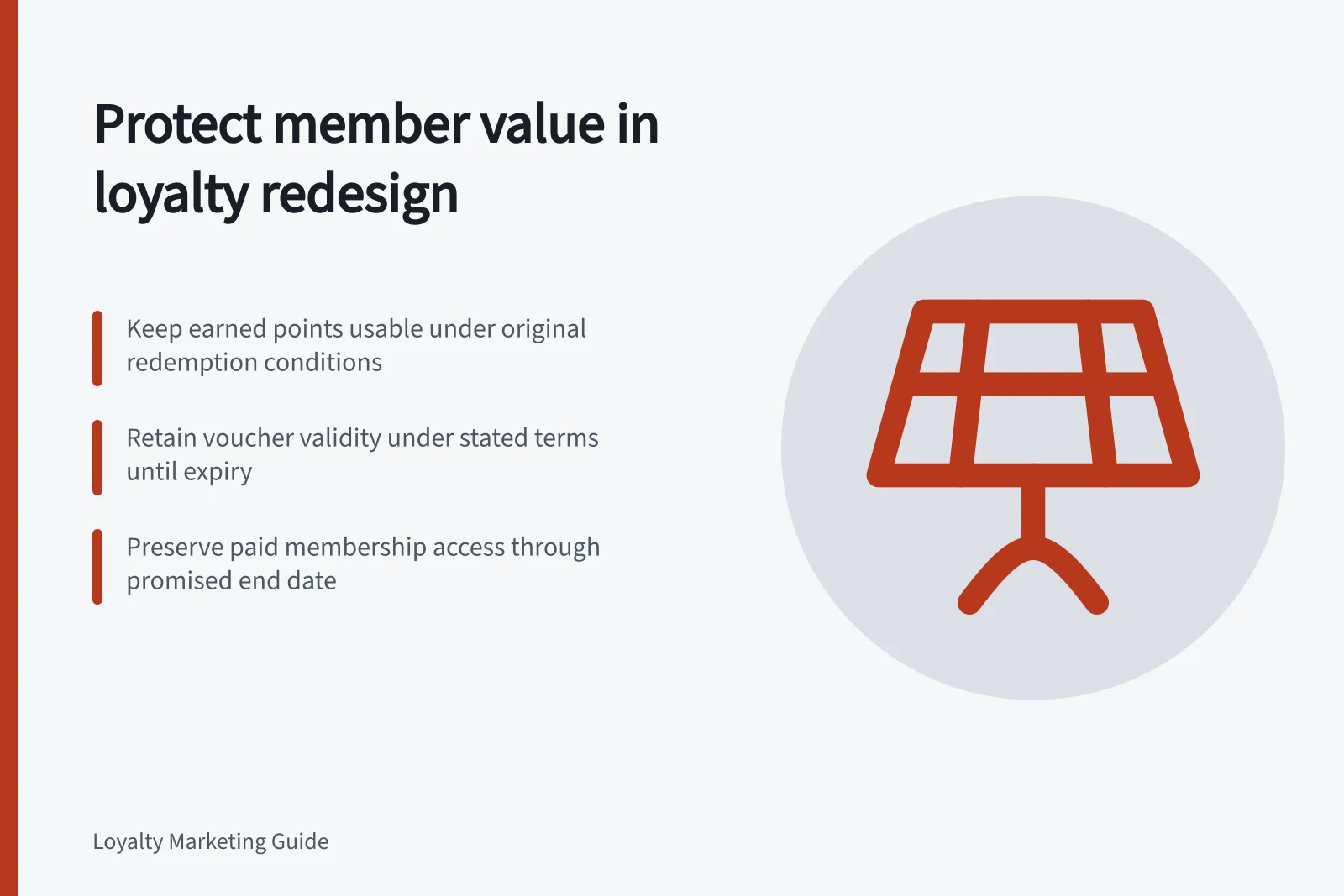
Use the applicable old conditions as the baseline: keep earned points usable under their stated redemption conditions, accept vouchers under their stated conditions, and retain the promised route for an existing booking or claim. Keep paid membership access through the end date already promised. Points, vouchers, bookings and membership access are separate entitlements.
For pending points, record the eligibility and approval rule tied to the earlier purchase. Keep the balance marked as pending until it is approved, then apply the treatment decided for points earned under the earlier rules.
Decide the transition before announcing it
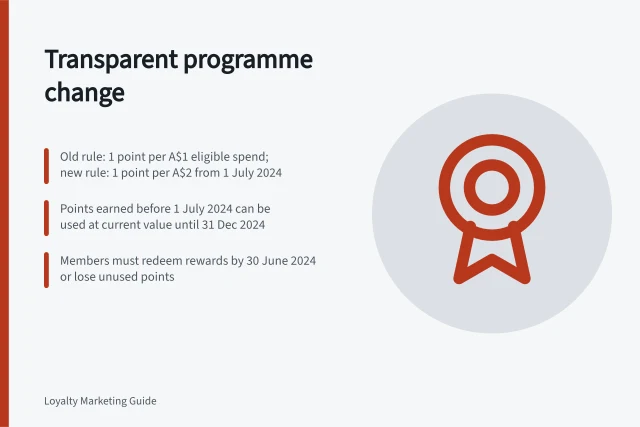
For each state, record the old rule, proposed rule, affected members, effective date and route to usable value. Keep existing earned or issued value under its stated conditions; apply changed earning or redemption rules to activity after the effective date.
Assess the actual terms and consequences of any change to point value or earn rate. Check how members can use existing points and whether a different transition is needed to keep the stated redemption route usable.
For an unused voucher, retain its stated conditions. For a booked service or claimed reward, keep a route to fulfilment and assess any supply failure against the actual offer and applicable consumer rights before deciding how to resolve it.
For a paid membership term, record the access already promised and its end date. Assess any proposed early change against the contract terms and applicable consumer rights; do not assume a refund or extension without a basis in the terms or law.
Check whether members can use the transition in practice. Eligible stock, working checkout, available appointments and time to obtain help all matter. A deadline provides little opportunity if the promised benefit cannot be claimed during it.
Explain the member's position
The Australian Consumer Law (ACL), part of the Competition and Consumer Act 2010, applies to consumers buying goods and services in Australia. It requires truthful information and contracts that are easy to understand and do not include unfair terms. Consumer guarantees for services include due care and skill, fitness for a stated purpose, and supply within a reasonable time if no timeframe was agreed.
Check the actual offer and contract against the ACL’s consumer guarantees and unfair contract terms rules. The ACCC shares guidance on loyalty schemes and accepts reports, but does not investigate individual complaints. State and territory consumer protection agencies manage individual complaints and issues with businesses in their jurisdictions.
Show the treatment and effective date for existing value in the account, reward catalogue, checkout and staff guidance. Keep definitions consistent. Show pending points as pending, and do not imply that an issued voucher has been used. Provide a route to query a missing transaction or affected booking.
Retain earlier wording and effective dates so activity around the cut-off can be explained. Check an order before and after it, a delayed award, a partial return and an unused reward against the proposed configuration. Assign an owner to exceptions before release.
After release, review failed claims, disputed balances and member questions. Correct a wrong account result with a traceable adjustment and an explanation to the affected member. A quiet complaints queue alone does not show that everyone understood or could use the revised offer.
Key Compliance and Member Protection Metrics
- ACL CoverageApplies to all loyalty schemes offering goods/services in Australia
- Consumer Guarantee – ServiceMust be provided with due care and skill, fit for purpose, within reasonable time
- Unfair Contract TermsProhibited under ACL if unconscionable or one-sided
- Privacy ObligationsPersonal information must be securely handled per OAIC guidelines
- Design Rights ProtectionVisual elements of loyalty programme may be protected under IP Australia