Rewards and Benefits
Part of Loyalty programme economics
Calculating the cost of a reward
Estimate the business cost of discounts, free products, delivery and partner rewards without confusing cost with advertised value.
Calculate a reward's cost from what the business pays, supplies or gives up when a member claims it. Points price, advertised saving and retail price answer different questions; none is automatically the business's cost.
Start with what the member receives
Record the reward's trigger, what is supplied, who pays for it and whether another purchase is required.
| Reward | Starting point for a planning estimate | Check separately |
|---|---|---|
| Discount on a purchase | Reduction in receipts on the same basket | Whether the purchase would have happened anyway. |
| Free added product | Variable supply and fulfilment costs | Whether it displaces a paid sale. |
| Free delivery | Added delivery and handling costs, plus any delivery charge otherwise collected | Whether the delivery costs or charges differ by basket. |
| Partner benefit | Contracted payment and costs the business bears | Claim fees, support and responsibility for failed fulfilment. |
| Service benefit | Added labour or capacity used | Whether it displaces paid work. |
Use a consistent revenue and cost basis. GST and supplier credits can affect the figures differently across reward structures; confirm the treatment in the business's accounts.
Add the costs caused by a claim
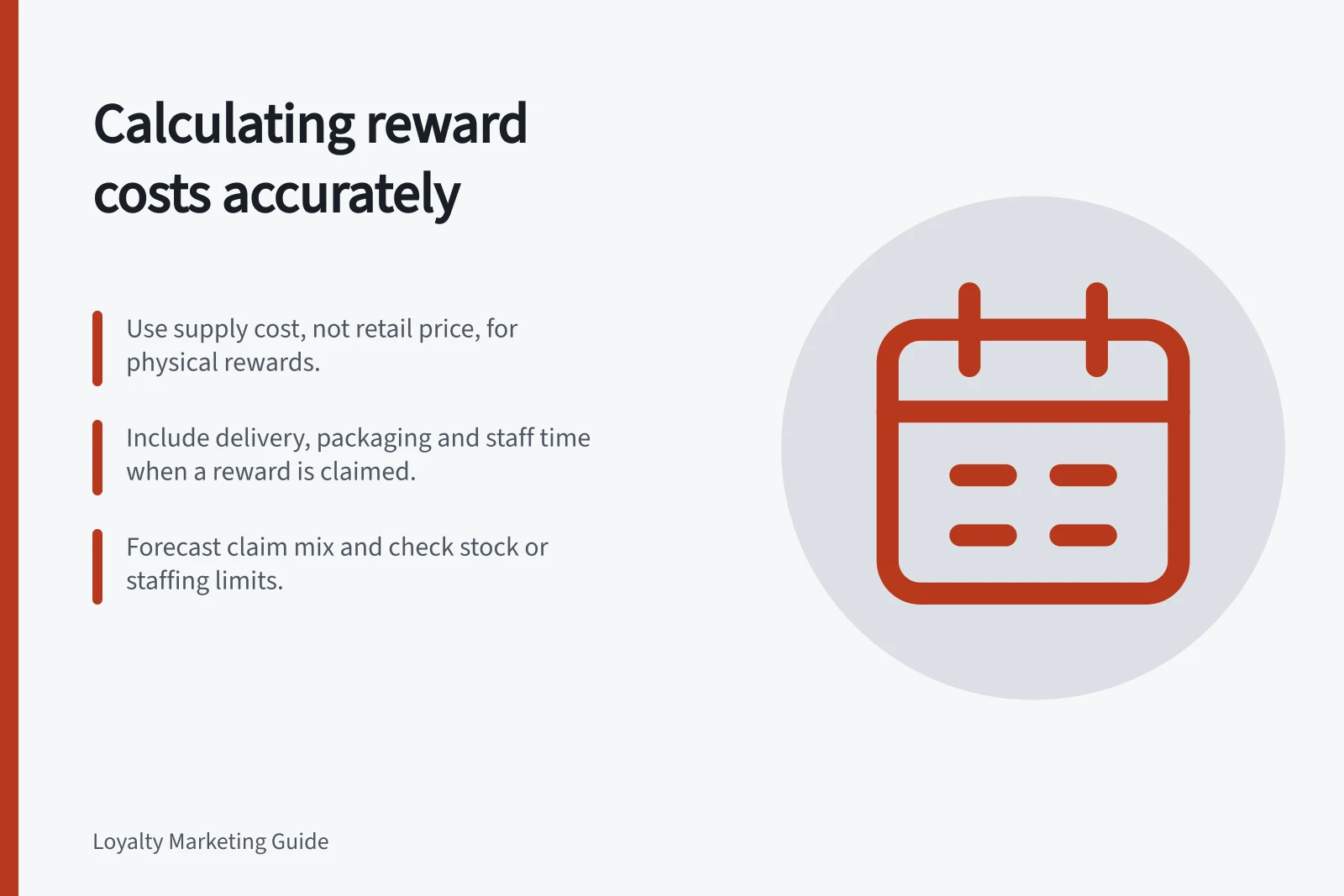
Include packaging, delivery, transaction or partner fees and extra staff time when they arise because the reward is claimed. For a physical item, use its expected supply cost rather than its shelf price.
If scarce stock would otherwise have been sold, model the lost contribution from that sale separately. Do not count both the full selling price and lost contribution for the same item.
For a discount, compare the same order with and without the reward. On an unchanged basket, an illustrative A$10 discount reduces customer payment by A$10.
The change in business receipts after GST depends on the basis used. Any extra purchase prompted by the offer belongs in the wider business case, not the reward's unit-cost estimate.
Suppose a free product has an assumed A$6 supply cost, A$2 packing cost and A$4 added delivery cost. One claim then uses A$12 of variable resources under those assumptions.
A displayed A$25 retail value does not make the fulfilment cost A$25. Assess a displaced paid sale separately if that is plausible.
Forecast claims and compare with actual costs
Multiply expected claims for each reward by its estimated unit cost, then add setup and running costs on separate lines. Where members can choose rewards, forecast the mix; the same number of redeemed points can lead to different costs.
Show a higher-use case and check any stock or staffing limit against the offer's terms. Make material limits clear to members.
The ACCC accepts reports about possible misleading or false claims, can require businesses to back up claims they make about their products or services, and may take compliance or enforcement action.
Keep member-facing value, operating cost and financial statement accounting distinct. Under AASB 15, points may require separate accounting if they give a material right. The applicable treatment depends on the offer and reporting period; it is not simply the product's fulfilment cost.
After launch, compare estimates with claims, invoices and support work by reward type. Delivery, substitutions and manual handling can change the actual cost substantially.