Rewards and Benefits
Part of Loyalty programme economics
Checking reward margin before launching a points offer
Test eligible baskets, redemption, returns and stacked promotions against order contribution before launching a points offer.
Before launching a points offer, calculate the contribution left on orders where members can earn and use points. Compare it with a plausible order without the offer.
A redeemed order can remain profitable while the offer still gives away margin on purchases that would have happened anyway.
Define the eligible basket
Write the proposed rule as a transaction: which items earn points, how many points they earn, what points buy and whether rewards can be combined with another promotion. Include minimum spends, exclusions, delivery terms and returns.
Test baskets likely to qualify, including a lower-margin basket, rather than only an average order.
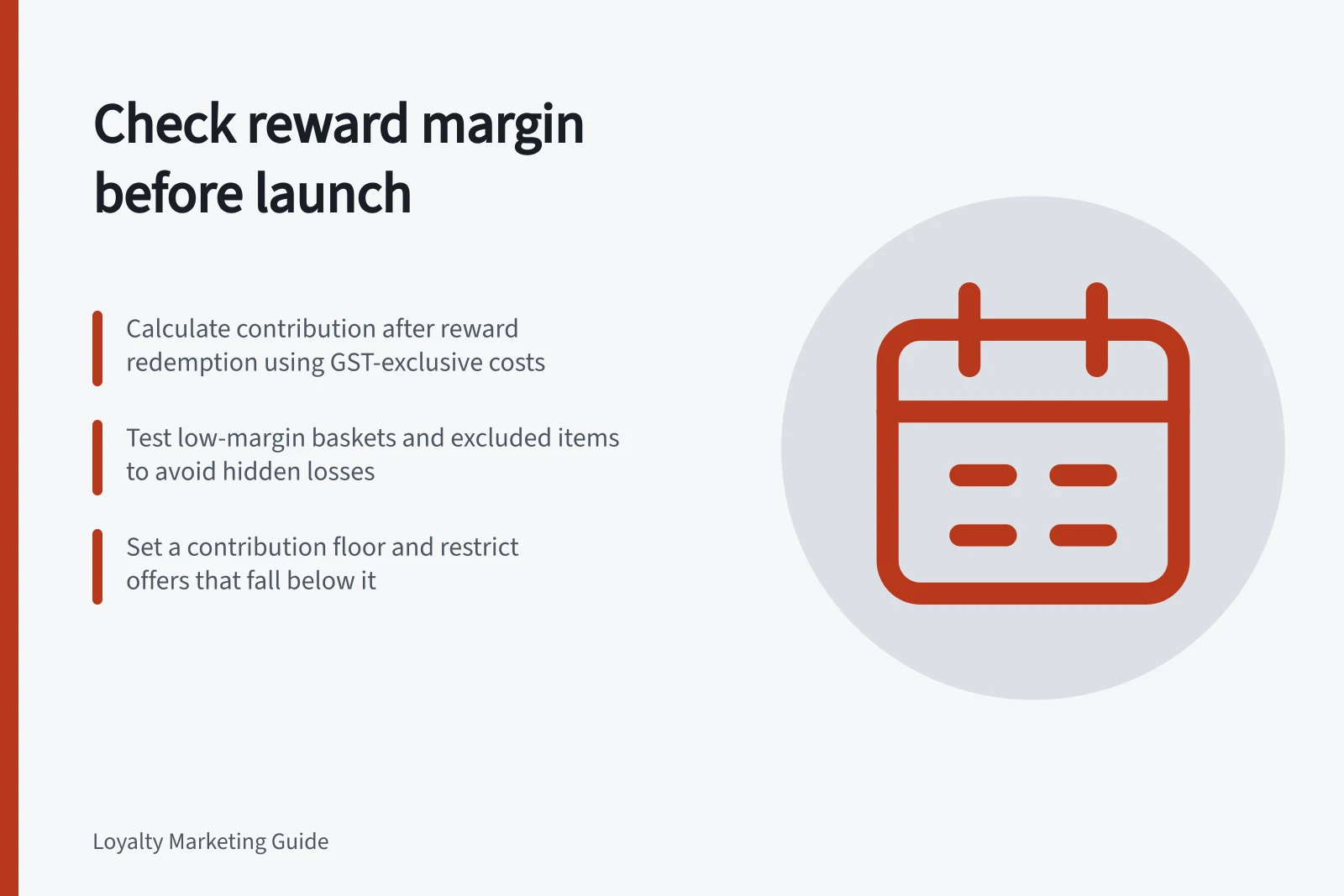
Use the same revenue and cost basis for each version of a basket. Include product, payment, packing and delivery costs that change with the order. Keep fixed programme costs separate from the order comparison.
Calculate contribution after redemption
For a hypothetical GST-exclusive example, suppose an eligible basket has A$100 of revenue and A$60 of variable costs. Contribution before a reward is A$40.
If a member uses an A$10 discount on the same GST-exclusive basis, and the basket and variable costs do not change, contribution becomes A$30 before other programme costs.
That A$30 is not proof of an A$30 programme gain. If the customer would have bought the basket without the reward, the offer reduces contribution by A$10 under these assumptions.
If the offer causes an otherwise absent purchase, the order contributes A$30 before other incremental costs. A purchase merely shifted from another date needs a longer comparison.
Scenario for the example / Planning result
- Same basket would have sold anyway
- A$10 less contribution from that order.
- Basket would not have sold without the offer
- A$30 contribution before other incremental costs.
- Basket is larger or contains different items
- Recalculate revenue and variable costs item by item.
These are conditional scenarios, not measured customer responses. An actual Australian offer needs figures prepared on the business's own GST basis.
Key Financial Metrics for Points Offer Evaluation
- Revenue (GST-exclusive)
- A$100
- Variable Costs (GST-exclusive)
- A$60
- Contribution After A$10 Discount
- A$30
Test combinations that reduce margin
Repeat the calculation for a discounted basket, a low-margin item, free delivery and any permitted reward stacking. Check whether the redemption order also earns points. If it does, estimate the future cost of those new points separately without charging the current redemption twice.
Check partial returns as well. A refund may reduce order contribution while delivery costs remain. Model what the rules say about points earned on returned items and any redeemed reward. The actual platform configuration still needs checking before launch; this calculation does not establish its behaviour.
Set a contribution floor from the business's own margins, then decide which baskets may earn or redeem and what stacking is allowed. If a permitted basket falls below the floor, change the offer or its eligibility. Advertise material restrictions clearly: the ACCC accepts reports about possible misleading or false claims, can require businesses to back up claims they make about their products or services, and may take compliance or enforcement action if a business misleads.
Record the assumptions and rule version used for the launch decision. Recalculate when prices, product costs or promotion rules change. This basket check does not measure programme-wide impact after launch.