Rewards and Benefits
Reward redemption experiences
Design reward redemption so members can find, afford and successfully use a reward under clear conditions.
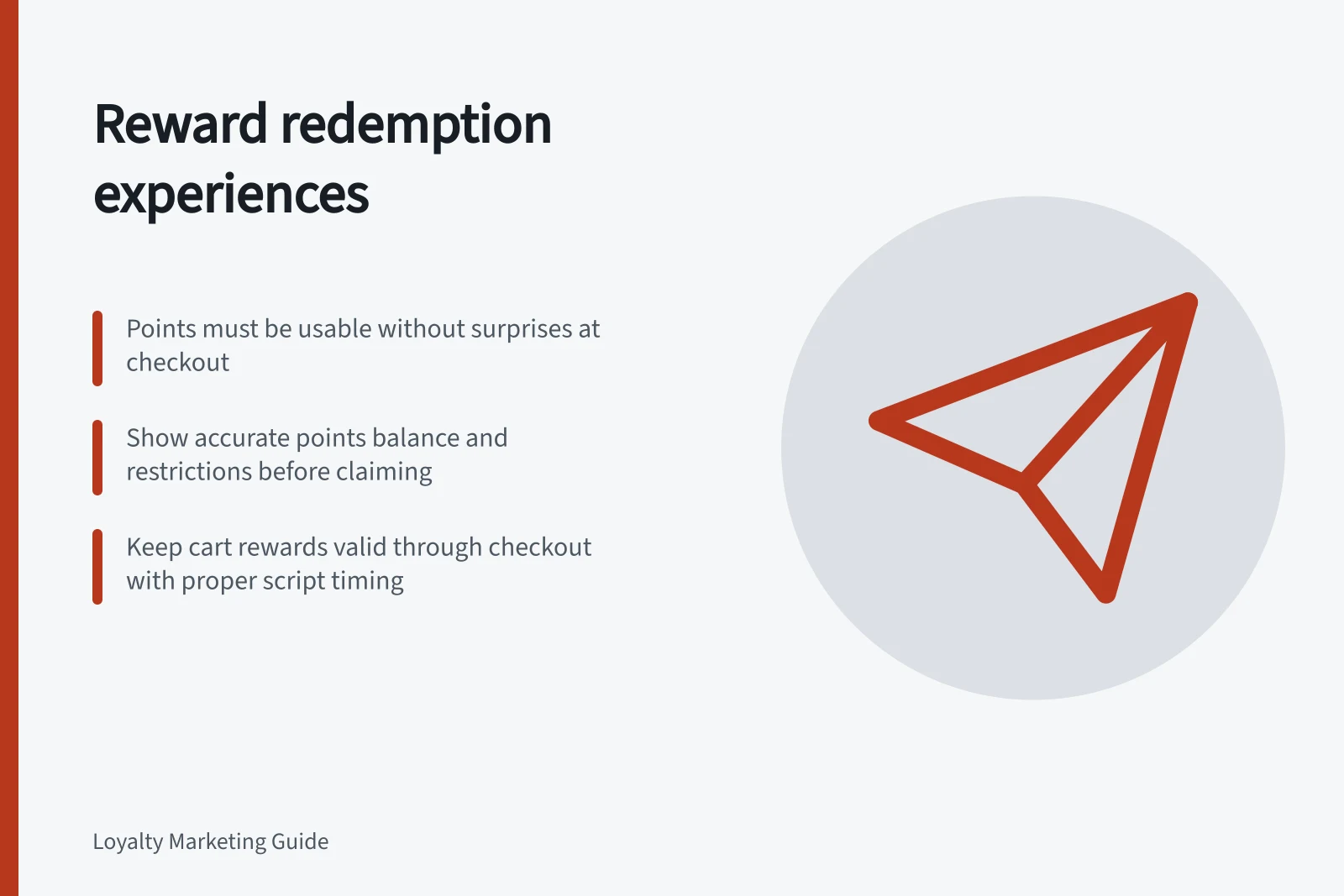
Points have value to a customer only if they can understand what is available and use it without a surprise at checkout.
Review redemption as a journey: discover a reward, see the conditions, claim it, apply it and learn what happened to the balance if the order changes.
Make the next step visible
Show an accurate points balance, the points required and any spend, product, channel or time restrictions before a member commits. Explain whether claiming a reward reserves it or whether it is used only when the purchase completes.
LoyaltyLion's in-cart design, for example, places a widget on the cart page so a shopper can spend points on a product and have it added to the cart without leaving that page, and it surfaces rewards already created. That is a platform example; the store must test its own configuration.
Keep cart rewards valid through checkout
A seamless free-product reward can depend on the rest of the basket: by default, at least one paid item must remain in the cart. Once the last paid item is removed, a full page reload takes the reward out of the cart, and that clean-up runs after the supporting script has loaded.
There can be a short gap between a basket change and its clean-up. A customer who removes the paid item and goes to checkout before the script loads may reach checkout with only the free item.
Stores using an AJAX cart, or another enhancement that changes the basket without a page reload, need to keep the cart state in step themselves.
In-cart reward installation also involves editing the Shopify theme; LoyaltyLion advises involving a developer if the store is not comfortable making those changes, because cart-template changes can affect checkout across the store.
Thresholds in brief
Reward thresholds need to be reachable within a realistic earning period.
The sibling article gives detailed guidance on choosing redemption thresholds customers can realistically reach.
Explain the redemption mechanics
A fixed discount has one points cost and one discount value: Smile gives the example of $5 off for 500 points. The customer redeems that exact combination and cannot change either amount. A fixed reward can also use decimal values, such as $4.50 off for 450 points.
An incremental discount lets a customer choose how many points to spend along a configured scale. For example, a customer with 512 points could spend 500 for $5 off or 300 for $3 off when the rate is $1 per 100 points. Smile's incremental rewards are online-only, unlike fixed rewards, which can be set up for online or POS use.
Show how the scale behaves before the customer confirms. Smile notes that incremental rewards are rounded to the nearest 100 points at redemption, so a displayed or selected amount should not leave members guessing how many points will actually be deducted.
Fixed vs Incremental Rewards (Smile.io)
- Fixed Reward$5 off for 500 points (exact match; no adjustment)
- Incremental Reward$1 off per 100 points; customer chooses how many points to spend (e.g. 500 = $5, 300 = $3)
- Available forFixed: online and POS | Incremental: online only
- Rounding ruleIncremental rewards rounded to nearest 100 points at redemption
Broken paths in the claim journey
Unavailable rewards are covered by the sibling article on handling unavailable rewards fairly.
State what happens to points when a claim fails or a purchase is reversed, so members can understand the outcome.
For programs spanning online and store channels, see the sibling article on testing redemption across channels.
Measure attempted, successful and failed redemptions separately, alongside support contacts.
Make programme terms dependable
The ACCC's 2019 draft report raised concerns about opaque terms preventing informed choices, unilateral changes to benefits and poor communication about how loyalty schemes work.
The ACCC also reported complaints from consumers who had not earned, kept or redeemed points as expected. Examples included schemes not adequately explaining that members had to remain active by earning or redeeming points to avoid expiry or restricted redemption opportunities.
Use these failure points to review the wording members rely on. Explain any activity requirement and what happens to points if it is not met, and communicate material changes to benefits clearly.
The ACCC said loyalty schemes must ensure they are not misleading consumers; unclear or outdated explanations can undermine confidence in the reward journey.
ACCC Concerns About Loyalty Schemes (Australia)
- Opaque terms
- Common issue preventing informed choices
- Unilateral changes
- Programs changing benefits without clear notice
- Points expiry issues
- Members unaware of activity requirements to retain points
- Consumer complaints
- Reported cases of unearned, lost or unredeemed points
In this guide
- Making an available reward easy to find and applyPlace reward information where eligible members can act, with points cost and conditions apparent before checkout.
- Choosing redemption thresholds customers can realistically reachSet reward thresholds from observed earning pace and customer value, then check who can realistically reach them.
- Handling unavailable rewards fairlyRespond to an unavailable loyalty reward with a clear status, point handling and a practical alternative.
- Testing reward redemption across online and in-store channelsTest a reward across online checkout and the till, including eligibility, cancellations and balance updates.