Rewards and Benefits
Part of Measuring loyalty programme impact
Measuring reward redemption alongside margin
Track reward claims and completed uses beside order contribution, fulfilment costs and refunds without treating redemption as incremental profit.
Measure whether members can use a promised reward, then examine the contribution left on the affected orders or services. Redemption alone shows use under the programme's definition; it does not show that the reward caused profitable additional purchases.
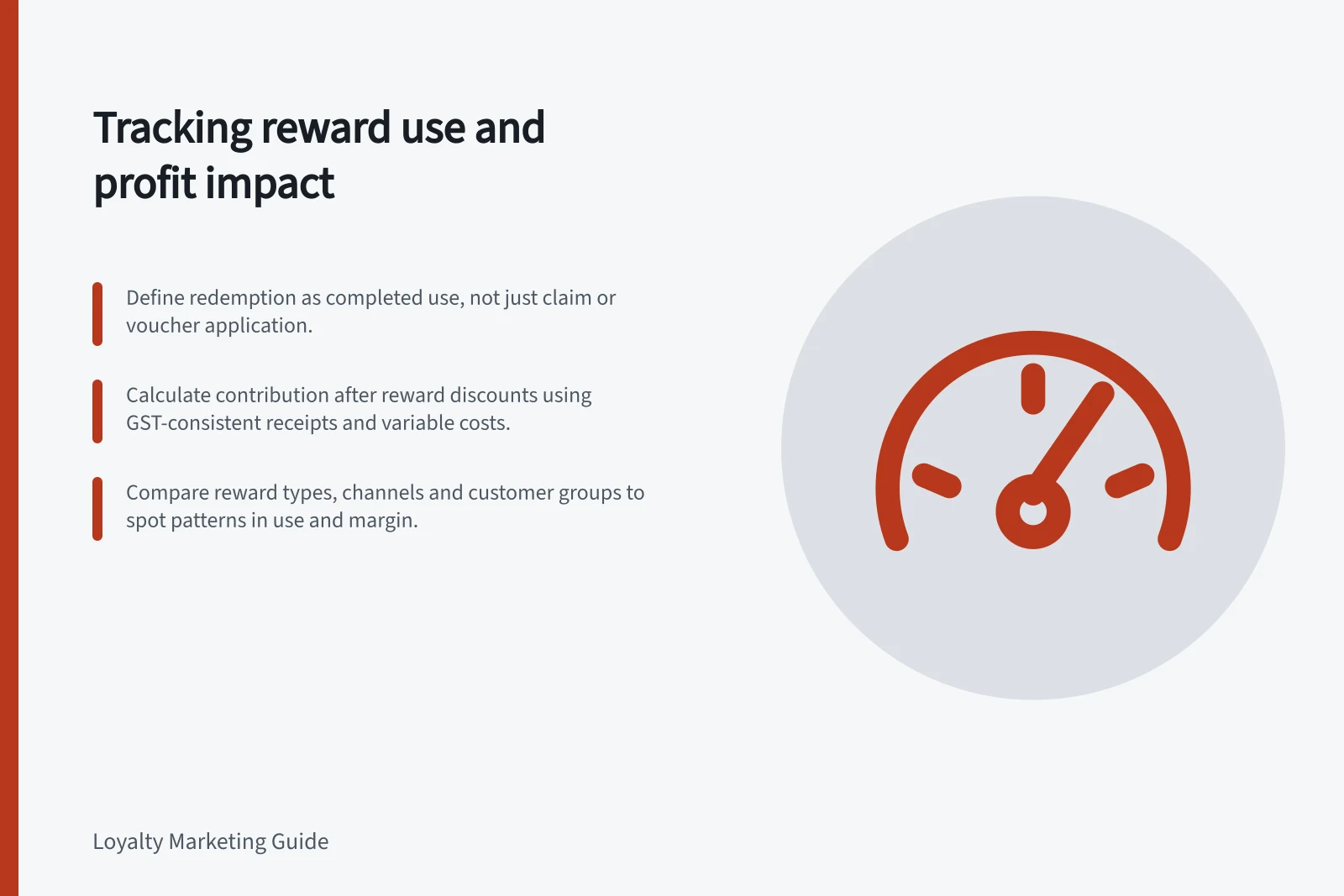
Define what was used
A reward may be available, claimed, applied to an order, fulfilled, cancelled or left unused, and systems can label different stages "redemption". Define the event before reporting a rate; where both exist, separate voucher claims from later uses, and count reward events and orders separately if one order can carry several rewards.
For each reward type, report how many members became eligible, how many claimed or attempted it, how many completed a use and how many claims failed, expired or remain open. Use a named denominator for every rate.
Completed uses divided by claims describes the path from claim to use. Orders with a completed reward use divided by orders eligible for that particular reward describes a different question. Neither is a universal redemption rate.
A service benefit may have no purchase order. In that case, connect the claim to its booking and delivery record rather than forcing it into an order-based rate. Check which events the actual loyalty and commerce systems record; an export field is not proof that failed attempts or fulfilment are captured.
Read use beside contribution
Connect each completed use to the affected order or service where possible. For an order, start with GST-consistent receipts after reward discounts and returns, then subtract the variable costs of that order. Add a benefit fulfilment cost only if it is absent from those order costs. State whether the report shows contribution in dollars, a margin percentage, or both.
For illustration, assume a basket has A$80 of GST-exclusive receipts before a reward and A$50 of variable costs. An A$8 discount leaves A$72 of receipts and A$22 of contribution before other programme costs, if the basket and costs are unchanged. The A$8 is already reflected in A$72 and should not be deducted again.
The A$22 is contribution on one rewarded order, not incremental programme value. If the customer would have bought the same basket anyway, the discount reduces contribution under these assumptions. A claim that the reward created extra purchasing needs a separate credible comparison.
Diagnose the pattern
Compare reward types, channels and relevant customer groups. Many claims but few completed uses may point to restrictions, stock or a difficult checkout path. High use with weak order contribution may warrant checking discount stacking and basket mix. These are possible explanations to investigate, not conclusions from the totals alone.
Review later refunds and the reward's actual status after a return. Do not assume that points or a voucher are automatically restored, or that every unused claim has no cost. Keep outstanding entitlements visible under the programme's terms. A concise review brings eligibility, claims, completed uses, failures, contribution, fulfilment costs and refunds into the same period and definitions.
Pros and Cons of Using Redemption Rate as a Performance Metric
- ProsSimple to track; useful for identifying claim-to-use drop-offs; helps audit system accuracy.
- ConsDoes not measure incremental profit; can overstate programme value if used without contribution analysis; ignores customer intent or purchase substitution.